11. Sustainable Development Goals (SDGs)
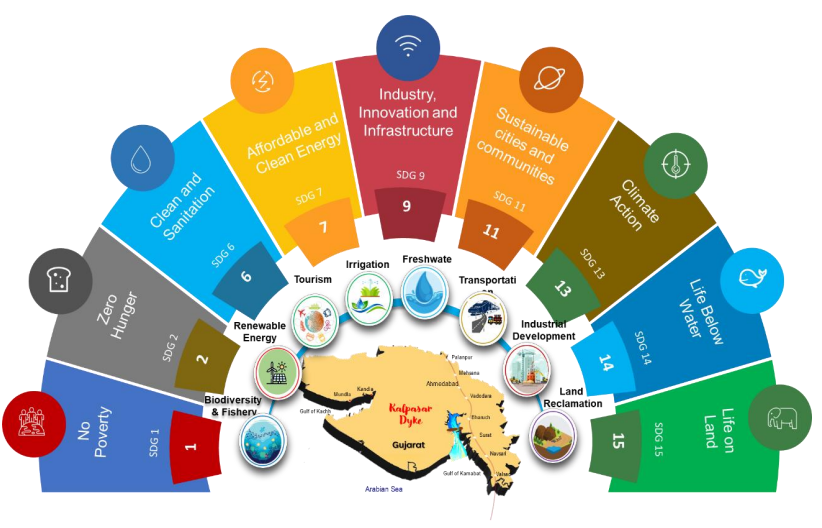
Kalpasar in Gujarat demonstrates synergistic SDG achievement. The ambitious project addresses water scarcity, energy demand, and SDGs. Building a massive freshwater reservoir to boost irrigation and clean drinking water, generating renewable energy, improving transportation infrastructure, reclaiming land, improving fisheries resources, and promoting environmental conservation and socioeconomic progress promotes sustainability and comprehensive development.
SDG 1 “No Poverty”
Its mission is to end poverty in all its forms by providing resources, basic services, and economic opportunities to all. It reduces vulnerability to climate-related extreme events and other economic, social, and environmental disasters. The Kalpasar Project creates a large freshwater lake from the Narmada (through Narmada Diversion Canal), Mahi, Sabarmati, and Dhadhar rivers to address poverty's many facets. It seeks to increase irrigation potential in arid Saurashtra to boost crop yields and diversify practises. Income for local farmers reduces poverty.
SDG 2 “End Hunger”
Provide nutritious and sufficient food for all, promote sustainable agriculture, support small-scale food producers, and address multiple malnutrition dimensions. SDG 2 promotes sustainable agriculture to reduce poverty, improve health, and protect the environment. Kalpasar Project's freshwater reservoir improves cropping pattern and productivity, increasing food production because it provides reliable water, preserves ecosystems, improves land and soil quality, and strengthens capacity to adapt to climate change, extreme weather, drought, flooding, and other disasters. Better food security reduces regional hunger and malnutrition. The main objective is to double small-scale food producers' agricultural productivity, incomes, land, other productive resources, inputs, knowledge, financial services, markets, value addition, and non-farm employment.
SDG 6 “Clean Water and Sanitation”
Seeks universal access and sustainable management. This goal prioritises safe, affordable drinking water. Water is key to poverty reduction and development. To reduce water scarcity and the number of people affected, the Kalpasar Project aims to increase water-use efficiency across all sectors and ensure sustainable freshwater withdrawals and supply. For community social and economic development, water-related ecosystems are protected and restored. The project aims to recharge groundwater, create 1,800 km² freshwater reservoir, and improve water quality. This project will reduce groundwater pressure by providing 4,215 MCM/year for irrigation. Kalpasar's advantages: (1) Provides clean drinking water to local communities, reducing waterborne diseases (2) Better sanitation and water availability for industry and agriculture.
SDG 7 “Affordable and Clean Energy”
Promotes universal access to clean, renewable energy. SDG 7's successful implementation helps create a more equitable and sustainable future for all because energy is essential to many other sustainable development goals. The Kalpasar Project seeks to significantly increase renewable energy in the global energy mix through clean energy research, technology, and investment. Developing 2,500 MW of renewable energy for Saurashtra water pumping and other uses. The project can generate wind and solar power. About 1,500 MW of wind and 1,000 MW of solar power are estimated.
SDG 9 “Industry, Innovation, and Infrastructure”
Promotes resilient infrastructure, inclusive and sustainable industrialization, and innovation. The goal is quality, reliable, sustainable regional and trans-border infrastructure to support economic development and human well-being with affordable and equitable access for all. Kalpasar Project invests in resilient infrastructure to boost industry and technology. By balancing economic growth with social and environmental concerns for a more equitable and prosperous future, it supports poverty reduction, sustainable cities and communities, and climate action. The Kalpasar Project will reduce distance and change travel patterns by connecting South Gujarat and Saurashtra with a multi-lane road and rail over the dyke. The 16-lane roads and 4-lane railways will shorten Saurashtra-Bharuch distance. Low logistics costs will boost these regions' competitiveness and economic activity. Stabilising the high-low tide difference could create 1 lakh Ha (public land between 5-6 and 6-7 contour intervals). Project reclaims land for industrial and community growth. Promote inclusive, safe, resilient, and sustainable cities.
SDG 11 “Sustainable Cities and Communities”
Improves urban planning, transport, housing, basic services, disaster resilience, and environmental quality to reduce inequalities, and boost sustainability. It prioritises urban-rural integration and cultural and natural heritage preservation. Kalpasar Project provides safe, affordable, and sustainable housing to reduce poverty. To boost Khambhat regional connectivity and growth, the project promotes inclusive, safe, resilient, and sustainable road and rail infrastructure. Improved road and rail networks, land reclamation, and sustainable urban planning improve living conditions and urban resilience in Kalpasar.
SDG 13 “Climate Action”
Calls for immediate and ambitious climate change action. It recognises that climate change impacts ecosystems and economies and requires global action. Mitigation (reducing greenhouse gas emissions) and adaptation are priorities. Preventing climate change's worst effects—more frequent and severe natural disasters, sea-level rise, and ecosystem and society disruptions—is crucial. By saving distance, the Kalpasar project reduces emissions and supports sustainable development. Kalpasar proposes shorter travel routes to reduce carbon footprint and emissions and renewable energy adoption to mitigate climate change.
SDG 14 “Life Below Water”
To protect marine resources for future generations, sustainable management and conservation are priorities. It addresses pollution, overfishing, and marine ecosystem degradation and urges international cooperation to restore marine environments. Kalpasar promotes marine resource and biodiversity conservation. A proposed dyke on the Gulf of Khambhat below the confluence of Mahi, Dhadhar, and Sabarmati would create freshwater discharges for multiple uses. It seeks to quickly restore fish stocks to biological maximum yield. A marine lake converted to a freshwater lake will replace less productive marine fisheries. Kalpasar freshwater reservoir would produce 2000 tonnes (Rs.150 million) initially and 20,000 tonnes (Rs.1500 million) fully developed. This will boost the state's 0.91 lac tonne inland fish production and 1.72 percent national contribution.
SDG 15 “Life on Land”
Protects, restores, and promotes sustainable use of terrestrial ecosystems, forests, and biodiversity. SDG 15 emphasises terrestrial ecosystems for biodiversity, climate regulation, and human and animal well-being. It addresses biodiversity loss, land degradation, etc. SDG 15 promotes sustainable land management, habitat conservation, and poaching and invasive species prevention to protect natural resources and ecosystems. The Kalpasar Project integrates ecosystem and biodiversity values into national and local planning, development, poverty reduction, and accounts. By controlling or eliminating priority species and reducing the impact of invasive alien species on land and water ecosystems, it reduces habitat degradation, biodiversity loss, and threatened species extinction. Kalpasar Project expects these benefits: Reclaimed land reduces soil degradation and promotes biodiversity, and improved water management increases soil fertility and vegetation growth.
12. Concluding Thoughts
The development of this Detailed Project Report (DPR) entailed several complex technical design challenges, necessitating a precise integration of various investigations, construction methodologies, and engineering economic considerations. The NCCR has effectively optimized each challenge by identifying experts in the relevant domains and engaging in negotiations to determine a feasible design solution. This document has been compiled by synthesizing and incorporating the findings of scientific research conducted by more than 28 organizations in the past, as well as the ongoing work of over 18 organizations. Possible benefits examined are:
- • Improvement in Water Regime: The water stored underground, after the construction of the freshwater reservoir will be amenable to more effective and efficient utilization by adopting better methods and modes of irrigation;
- • Improvement in Soil Productivity: With the massive water input, the soil salinity level will gradually reduce, the soil condition will improve, leading to soil productivity;
- • Changing in Cropping Pattern: With the introduction of irrigation, there will be a shift from the existing system of mainly un-irrigated agriculture to irrigated agriculture. The farmers will respond favourably to the water made available to them for higher return;
- • Transportation: The construction of dyke road across the Gulf of Khambhat will connect the Saurashtra region with South Gujarat; significantly reducing the transport distance (by about 180 km) and time will be saved (from 6 hours to 1.5 hour) and thereby reducing the direct and indirect costs of transportation;
- • Renewable Energy: Kalpasar Project has potential to harness renewable energy through wind and solar power development. The estimated potential capacity is about 1,500 MW by wind power and around 1,000 MW by solar power;
- • Tourism: With the Kalpasar dyke connecting the Gulf, the tourism potential is likely to increase and waterfront development activities can be taken up in the adjoining newly created land;
- • Fisheries: The transformation of marine water lake into a freshwater lake will lead to shifting of marine fisheries by freshwater fisheries.
After detailed consideration, extensive deliberation and scientific studies on the engineering and technical challenges, economic viability and socio-economic impacts of the project, this DPR concludes that the Kalpasar Project is technically feasible and economically viable for the benefit of the State of Gujarat. Further, the implementation of this project will boost the technical competence of the nation and build confidence in the people of India to undertake in future such challenging and integrated projects.